Parliament passes NRN bill
Nepalnews.com, 13-Aug-2007
The Legislature Parliament has passed the much awaited Non Resident Nepali (NRN) bill on Monday.
The bill defined NRN as those Nepalis living in foreign land for more than two years, either holding Nepali citizenship or foreign citizenship. Earlier, the draft bill had proposed the period of 182 days. However, Nepalis living in SAARC member countries are not entitled to be categorized as NRN.
The new bill has paved way for registration of the organisation in Nepal, which had been one of the major demands of the NRN Association.
The bill has provisioned for issuance of NRN identity cards to those entitled. The card is valid till the expiry of the visa the person holds, not exceeding 10 years, for Nepali nationals living abroad, while Nepalis having foreign citizenship will have to renew the card every two years.
A person would continue to be a NRN even if he stays in Nepal or owns a business here.
Any company in which a NRN has more than 50 percent share can invest in projects or sectors that the government opens for foreign investment.
Presenting the bill at the house, Foreign Minister Sahana Pradhan said the NRN bill has been brought to encourage the Nepali Diaspora for development of the country.
NRN Association had demanded that the bill be passed before its third convention scheduled for October 15-17 in Kathmandu.
Showing posts with label FDI. Show all posts
Showing posts with label FDI. Show all posts
Monday, September 03, 2007

Morang-Sunsari corridor to become SEZ
Morang-Sunsari corridor to become SEZ
eKantipur.com, 11-Aug-2007
The government is preparing to declare Morang-Sunsari industrial corridor as a special economic zone (SEZ) and extend facilities to industries accordingly, said Finance Minister Dr Ram Sharan Mahat.
"The government has already moved ahead in this regard. Entrepreneurs can remain assured that the announcement on it will come soon," said he.
The Finance Minister (FM) made the commitment to a delegation of industrialists from Morang, who met him on Friday demanding that the government recognize the Morang-Sunsari corridor as the industrial area and extend facilities to promote it.
Mahesh Jaju, an entrepreneur who was also in the delegation, told the Post that the FM also informed the delegation that Prime Minister Girija Prasad Koirala has already directed him to expedite the process toward granting facilities to the industries in the corridor.
"The government will soon declare the corridor as an SEZ," said Jaju.
Once declared, industries in the corridor will enjoy income tax holiday for 5 years, exemption on customs duty, VAT and excise duty on the import of raw materials and special discount on rental charge, according to entrepreneurs.
Most importantly, the announcement will prevent workers from disturbing the manufacturing process although they will be allowed to organize under various trade unions.
President of Nepali Congress Morang district, Amrit Aryal, had also submitted a memorandum to the PM last week, when he was in the home town, seeking recognition of the corridor as a special economic zone.
Entrepreneurs had also warned the government of shutting down the industries if it ignored the establishment of an SEZ in the area.
Immediately after receiving the memorandum, the PM had directed the finance minister to work for announcing the corridor as an SEZ and providing facilities to investors accordingly.
eKantipur.com, 11-Aug-2007
The government is preparing to declare Morang-Sunsari industrial corridor as a special economic zone (SEZ) and extend facilities to industries accordingly, said Finance Minister Dr Ram Sharan Mahat.
"The government has already moved ahead in this regard. Entrepreneurs can remain assured that the announcement on it will come soon," said he.
The Finance Minister (FM) made the commitment to a delegation of industrialists from Morang, who met him on Friday demanding that the government recognize the Morang-Sunsari corridor as the industrial area and extend facilities to promote it.
Mahesh Jaju, an entrepreneur who was also in the delegation, told the Post that the FM also informed the delegation that Prime Minister Girija Prasad Koirala has already directed him to expedite the process toward granting facilities to the industries in the corridor.
"The government will soon declare the corridor as an SEZ," said Jaju.
Once declared, industries in the corridor will enjoy income tax holiday for 5 years, exemption on customs duty, VAT and excise duty on the import of raw materials and special discount on rental charge, according to entrepreneurs.
Most importantly, the announcement will prevent workers from disturbing the manufacturing process although they will be allowed to organize under various trade unions.
President of Nepali Congress Morang district, Amrit Aryal, had also submitted a memorandum to the PM last week, when he was in the home town, seeking recognition of the corridor as a special economic zone.
Entrepreneurs had also warned the government of shutting down the industries if it ignored the establishment of an SEZ in the area.
Immediately after receiving the memorandum, the PM had directed the finance minister to work for announcing the corridor as an SEZ and providing facilities to investors accordingly.
Sunday, June 24, 2007
Nepali firms to go multinational
Nepali firms to go multinational
eKantipur.com, 21-Jun-2007
Now is the time for established domestic companies to think of going multinational. If things go according to plan, the over four-decade long restriction on Nepali investors to invest abroad will be lifted within a month, paving the way for Nepali entrepreneurs to go multinational.
According to an official at the Finance Ministry, the government is in the final stages of amending the Ban on Nepali Investment in Foreign Countries 2021 Act, as per the long-standing demands of some potential Nepali businessmen willing to invest abroad. The government is attempting to bring policy level changes in the upcoming budget for fiscal year 2007/08.
Industrial experts and government officials say that well-established domestic service-based industries, like the food industry, have shown strong interest to expand their bases in foreign countries.
"We believe the food industry, particularly instant noodles, established-restaurant chains and cable transporters can reap benefits by going multinational once the ban is lifted," said a high-ranking official.
Finance Minister Dr Ram Sharan Mahat acknowledged the development and said that demand for lifting the ban is high from Nepali business community. "The government is positive on allowing Nepali companies to invest in foreign countries, but it will come with conditions," Dr Mahat said.
The official said the government is thinking on three ways to allow Nepali investors to invest abroad. First is through creating a mutual fund, established by financially sound banks with its majority equity participation. Organized investors, including individuals can participate in the fund by purchasing units of the fund.
Second is by allowing investments of Nepali companies through transfer of technology while the third way is by permitting Nepal-based holding companies to establish their subsidiaries in foreign lands.
eKantipur.com, 21-Jun-2007
Now is the time for established domestic companies to think of going multinational. If things go according to plan, the over four-decade long restriction on Nepali investors to invest abroad will be lifted within a month, paving the way for Nepali entrepreneurs to go multinational.
According to an official at the Finance Ministry, the government is in the final stages of amending the Ban on Nepali Investment in Foreign Countries 2021 Act, as per the long-standing demands of some potential Nepali businessmen willing to invest abroad. The government is attempting to bring policy level changes in the upcoming budget for fiscal year 2007/08.
Industrial experts and government officials say that well-established domestic service-based industries, like the food industry, have shown strong interest to expand their bases in foreign countries.
"We believe the food industry, particularly instant noodles, established-restaurant chains and cable transporters can reap benefits by going multinational once the ban is lifted," said a high-ranking official.
Finance Minister Dr Ram Sharan Mahat acknowledged the development and said that demand for lifting the ban is high from Nepali business community. "The government is positive on allowing Nepali companies to invest in foreign countries, but it will come with conditions," Dr Mahat said.
The official said the government is thinking on three ways to allow Nepali investors to invest abroad. First is through creating a mutual fund, established by financially sound banks with its majority equity participation. Organized investors, including individuals can participate in the fund by purchasing units of the fund.
Second is by allowing investments of Nepali companies through transfer of technology while the third way is by permitting Nepal-based holding companies to establish their subsidiaries in foreign lands.
Govt approves SEZ Act
Govt approves SEZ Act
eKantipur.com, 20-Jun-2007
BY MILAN MANI SHARMA
After years of debate, the government has finally endorsed the Special Economic Zone (SEZ) Act, incorporating better tax incentives and flexible labor provisions for entrepreneurs in the zone.
The Act would soon be forwarded to the House of Representatives for enactment, said acting Industry Secretary Purushottam Ojha.
Referring to provisions of the Act, Ojha told the Post that it upholds three broader principles: incentives to industries, one-spot service and labor flexibility.
The Act treats SEZ as a land where other domestic laws related to labor and industries would not be applicable. It has mooted an autonomous SEZ Authority to oversee its operations.
The Act, however, is still weak on labor related provisions, said officials involved in the formulation of Act, adding that provisions to tighten 'labor indiscipline' proposed initially has been diluted in the approved Act.
Nevertheless, while allowing workers to unite and practice collective bargaining, it prohibits workers from undertaking activities that affect production and normal operations of industries.
The Act allows entrepreneurs to hire workers on contract basis. “Terms of recruitment, facilities and lay off would be governed by the agreement the worker and management would sign while accepting the job.”
Initially, officials had pushed for 'hire and fire' provision as demanded by entrepreneurs.
The Act says that facilities for workers in the SEZ should be better than what workers receive outside of the zone. “SEZ Authority will see that workers pay scale, medical and insurance facilities are better than others,” reads the Act.
In order to lure investors in SEZ, the government has decided to provide them with facilities such as duty-free import of raw materials, exemption of value added tax (VAT) and free them from excise duty and other local taxes.
“The industries in SEZ will be provided with income tax holiday for five years,” says the Act. After five years also, they would be provided with 50 percent discount on income tax.
In order to ensure investment guarantee, the Act says industries already into operation would continue to enjoy all the facilities, even if later amendments changed the structure and extent of facilities.
Going by the Act, only export-oriented industries can be set up in SEZ. Nevertheless the government has allowed them to make domestic sales not exceeding 15 percent of their transactions.
SEZ Authority, to be led by an independent expert, would initially lease the land in SEZ for 30 years. Also, 50 percent, 40 percent and 25 percent discounts will be provided on lease rent for the first three years of investment. After 30 years, lease agreement can be renewed in every 5 years.
The Act has asked SEZ Authority to provide one-spot services so that foreign and domestic investors would not have to take the trouble of approaching different government offices.
The vision of the Act is to provide services like visa, visa renewal, logistics and other facilities through a special office of SEZ Authority.
eKantipur.com, 20-Jun-2007
BY MILAN MANI SHARMA
After years of debate, the government has finally endorsed the Special Economic Zone (SEZ) Act, incorporating better tax incentives and flexible labor provisions for entrepreneurs in the zone.
The Act would soon be forwarded to the House of Representatives for enactment, said acting Industry Secretary Purushottam Ojha.
Referring to provisions of the Act, Ojha told the Post that it upholds three broader principles: incentives to industries, one-spot service and labor flexibility.
The Act treats SEZ as a land where other domestic laws related to labor and industries would not be applicable. It has mooted an autonomous SEZ Authority to oversee its operations.
The Act, however, is still weak on labor related provisions, said officials involved in the formulation of Act, adding that provisions to tighten 'labor indiscipline' proposed initially has been diluted in the approved Act.
Nevertheless, while allowing workers to unite and practice collective bargaining, it prohibits workers from undertaking activities that affect production and normal operations of industries.
The Act allows entrepreneurs to hire workers on contract basis. “Terms of recruitment, facilities and lay off would be governed by the agreement the worker and management would sign while accepting the job.”
Initially, officials had pushed for 'hire and fire' provision as demanded by entrepreneurs.
The Act says that facilities for workers in the SEZ should be better than what workers receive outside of the zone. “SEZ Authority will see that workers pay scale, medical and insurance facilities are better than others,” reads the Act.
In order to lure investors in SEZ, the government has decided to provide them with facilities such as duty-free import of raw materials, exemption of value added tax (VAT) and free them from excise duty and other local taxes.
“The industries in SEZ will be provided with income tax holiday for five years,” says the Act. After five years also, they would be provided with 50 percent discount on income tax.
In order to ensure investment guarantee, the Act says industries already into operation would continue to enjoy all the facilities, even if later amendments changed the structure and extent of facilities.
Going by the Act, only export-oriented industries can be set up in SEZ. Nevertheless the government has allowed them to make domestic sales not exceeding 15 percent of their transactions.
SEZ Authority, to be led by an independent expert, would initially lease the land in SEZ for 30 years. Also, 50 percent, 40 percent and 25 percent discounts will be provided on lease rent for the first three years of investment. After 30 years, lease agreement can be renewed in every 5 years.
The Act has asked SEZ Authority to provide one-spot services so that foreign and domestic investors would not have to take the trouble of approaching different government offices.
The vision of the Act is to provide services like visa, visa renewal, logistics and other facilities through a special office of SEZ Authority.
Saturday, June 16, 2007
Another industry packs up
Another industry packs up
eKantipur.com, 12-Jun-2007
Citing security problem, Crescent Industries -- one of the leading joint venture companies of the district -- has shut down its operations and has decided to shift to Nigeria.
The industry was established four years ago with investment totaling Rs 500 million, including 40 percent shares from Minakshi Group of Industries of Kolkata. It had capacity to employ 500 persons in its corrugated sheet manufacturing plant.
Madan Koirala, managing director of the industry, said that the industry was forced to take the unpleasant step as it could not withstand threats and intimidations coming from various armed groups.
Tiger, an infamous local armed group, and other groups were demanding huge amount of money from the company.
The closure of industry has affected a dozen VDCs of the district. It was generating employment and giving boost to economic activities in those VDCs.
The industry unveiled its plan to shift to Nigeria on Monday after it shipped its plants into Indian territory.
Meanwhile, business community of the eastern region has dubbed the incident as 'unfortunate' and raised serious questions over government's commitment to protect investment coming into the country. “The industry's decision to relocate outside the country is very unfortunate,” Mahesh Kumar Jaju, senior vice president of Morang Trade Association, told the Post.
Suka Dev Mehta, president of Inaruwa Chamber of Commerce and Industry lambasted the local administration and government for not being serious to improve industrial security.
“Entrepreneurs are not seeking industrial security for nothing. The government must be serious toward it,” said Mehta, urging the eight-political parties in the government to work for restoring business environment in the country.
eKantipur.com, 12-Jun-2007
Citing security problem, Crescent Industries -- one of the leading joint venture companies of the district -- has shut down its operations and has decided to shift to Nigeria.
The industry was established four years ago with investment totaling Rs 500 million, including 40 percent shares from Minakshi Group of Industries of Kolkata. It had capacity to employ 500 persons in its corrugated sheet manufacturing plant.
Madan Koirala, managing director of the industry, said that the industry was forced to take the unpleasant step as it could not withstand threats and intimidations coming from various armed groups.
Tiger, an infamous local armed group, and other groups were demanding huge amount of money from the company.
The closure of industry has affected a dozen VDCs of the district. It was generating employment and giving boost to economic activities in those VDCs.
The industry unveiled its plan to shift to Nigeria on Monday after it shipped its plants into Indian territory.
Meanwhile, business community of the eastern region has dubbed the incident as 'unfortunate' and raised serious questions over government's commitment to protect investment coming into the country. “The industry's decision to relocate outside the country is very unfortunate,” Mahesh Kumar Jaju, senior vice president of Morang Trade Association, told the Post.
Suka Dev Mehta, president of Inaruwa Chamber of Commerce and Industry lambasted the local administration and government for not being serious to improve industrial security.
“Entrepreneurs are not seeking industrial security for nothing. The government must be serious toward it,” said Mehta, urging the eight-political parties in the government to work for restoring business environment in the country.
Wednesday, May 23, 2007
Melamchi is dead: Unable to continue after June 30: ADB
Melamchi is dead: Unable to continue after June 30: ADB
eKantipur.com, 22-May-07
BY BIKASH SANGRAULA
Six years after entering construction, Melamchi, the country's largest development project, met a sad demise Tuesday, with the Asian Development Bank (ADB), the project's principal donor, saying it cannot extend its loan commitment to the project.
"As it stands now, it would not be possible to carry on with project activities, with the project closing on 30 June 2007. In such difficult circumstances, it is now for the government to decide how it wishes to proceed," said ADB in a statement issued Tuesday, a day after withdrawal by UK firm Severn Trent Water International (STWI) of a contract bid to manage Kathmandu Valley's water supply.
Appointment of a management contractor was a critical covenant in ADB's funding commitment to the project. After Minister of Physical Planning and Works Hisila Yami halted the contract award on May 8, the bank had repeatedly urged the government to award it, stating that without it the bank would be unable to extend its funding commitment. A cabinet meeting in the previous government had decided to award the contract to STWI, which was the sole bidder.
"A key provision of the loan agreement signed between the Government of Nepal and ADB on 24 January 2001 was that the restructuring of Nepal Water Supply Corporation and award of a private sector management contract for delivery of water services under competitive procedures must be completed prior to initiation of civil works contracting for the construction of the diversion tunnel from Melamchi Valley to Kathmandu," the bank said in the statement.
This provision of the loan agreement recognized that the chronic water shortages affecting Kathmandu are caused not only by lack of supply infrastructure and bulk water resources, but also by poor management of water services, the Bank has added in the statement.
"The signing of the private management contract was the very last stage of a long process to achieve the agreed institutional reform for efficient utilization of Melamchi's water. This long process, which has required six years of effort, cannot be completed now that the water utility operator is unable to obtain approval from the Government to sign the duly negotiated contract and the final bid validity has been withdrawn on 15 May 2007 (after nine extensions made since March 2006)," the bank has further said.
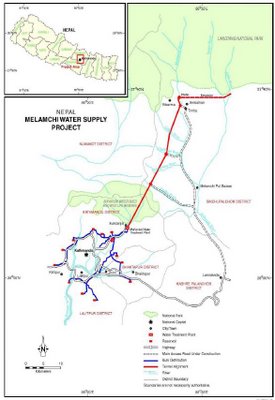
Melamchi project, which was scaled down from the original estimated cost of US $ 464 million to US $ 350 million in March this year, was designed to supply 170 million liters of water daily from Melamchi River in Sindhupalchowk district to Sundarijal in Kathmandu through a 26.5-km diversion tunnel. ADB had committed US $ 165 million to the project.
The daily demand of water in Kathmandu Valley is 250 million liters, while the supply is less than one-third the demand.
Source: Melamchi Water Supply (pdf), Asian Development Bank
eKantipur.com, 22-May-07
BY BIKASH SANGRAULA
Six years after entering construction, Melamchi, the country's largest development project, met a sad demise Tuesday, with the Asian Development Bank (ADB), the project's principal donor, saying it cannot extend its loan commitment to the project.
"As it stands now, it would not be possible to carry on with project activities, with the project closing on 30 June 2007. In such difficult circumstances, it is now for the government to decide how it wishes to proceed," said ADB in a statement issued Tuesday, a day after withdrawal by UK firm Severn Trent Water International (STWI) of a contract bid to manage Kathmandu Valley's water supply.
Appointment of a management contractor was a critical covenant in ADB's funding commitment to the project. After Minister of Physical Planning and Works Hisila Yami halted the contract award on May 8, the bank had repeatedly urged the government to award it, stating that without it the bank would be unable to extend its funding commitment. A cabinet meeting in the previous government had decided to award the contract to STWI, which was the sole bidder.
"A key provision of the loan agreement signed between the Government of Nepal and ADB on 24 January 2001 was that the restructuring of Nepal Water Supply Corporation and award of a private sector management contract for delivery of water services under competitive procedures must be completed prior to initiation of civil works contracting for the construction of the diversion tunnel from Melamchi Valley to Kathmandu," the bank said in the statement.
This provision of the loan agreement recognized that the chronic water shortages affecting Kathmandu are caused not only by lack of supply infrastructure and bulk water resources, but also by poor management of water services, the Bank has added in the statement.
"The signing of the private management contract was the very last stage of a long process to achieve the agreed institutional reform for efficient utilization of Melamchi's water. This long process, which has required six years of effort, cannot be completed now that the water utility operator is unable to obtain approval from the Government to sign the duly negotiated contract and the final bid validity has been withdrawn on 15 May 2007 (after nine extensions made since March 2006)," the bank has further said.
Melamchi project, which was scaled down from the original estimated cost of US $ 464 million to US $ 350 million in March this year, was designed to supply 170 million liters of water daily from Melamchi River in Sindhupalchowk district to Sundarijal in Kathmandu through a 26.5-km diversion tunnel. ADB had committed US $ 165 million to the project.
The daily demand of water in Kathmandu Valley is 250 million liters, while the supply is less than one-third the demand.
Source: Melamchi Water Supply (pdf), Asian Development Bank

Global Economy. Southern Transnationals: The New Kids on the Block?
Global Economy. Southern Transnationals: The New Kids on the Block?
Global Research, April 30, 2007
by Kavaljit Singh
The mid-1990s witnessed the dramatic emergence of transnational corporations from the developing world. Although much of the investment by these corporations is concentrated in other developing countries (South-South), they are increasingly investing heavily in developed countries (South-North) as well. The South-South and South-North FDI flows are growing much faster than the traditional North-South FDI flows. However, 87 per cent of the total outward FDI flows in 2004 originated from just 10 developing countries.
In terms of foreign assets, the majority of top 50 Southern TNCs are headquartered in Asia (32), followed by Latin America (11) and Africa (7, all of them in South Africa ). What is interesting to note is that the increase in FDI outflows is concentrated in many of the same countries that receive the bulk of FDI inflows to developing countries such as China , Brazil , India , South Africa , and Mexico . Outward FDI from China increased from a meager $400 million in 1980 to $38 billion by the end of 2004. China is also the second largest investor in Africa, after the US . In the case of India , there were 136 outward investment deals valued at $4.3 billion in 2005. The value of outward foreign investment by Indian firms almost nears the level of inward foreign investment. With the lifting of international sanctions and the relaxation of capital controls, South African TNCs such as the Anglo American Corporation, De Beers, and SABMiller have become dominant players in the African region. In the words of Graham Mackay, CEO of SABMiller, “If there was any more of Africa , we would be investing in it. The return on investments here ( Africa ) has been fantastic.” [1]
The motivations behind cross-border investments by Southern TNCs are not different from others. To a large extent, competition pressures arising from globalization processes (such as liberalization of imports and inward FDI) drive Southern corporations to invest abroad. Like their Northern counterparts, the Southern TNCs are investing abroad to gain access to natural resources, markets, skills, and technology. In some recent cases, acquiring brand names (such as the acquisition of IBM’s personal computer division by China ’s Lenovo) seems to be the prime motive.
To a large extent, the expansion of South-South and South-North investment flows reflects the increasing integration of developing countries into the world economy. A number of important factors including regional integration through trade and investment agreements, trade and financial liberalization, increasing wealth as well as limited market size and resource base at home have encouraged Southern TNCs to invest abroad.
Instead of investing in greenfield projects, however, Southern transnationals are increasingly undertaking investments through acquisitions. Recently announced buyout deals (such as Beijing-based Lenovo’s purchase of IBM’s PC business and the acquisition by Mexican company Cemex of the UK ’s RMC) suggest that Southern TNCs are more actively engaged in M&A deals. The bulk of India ’s outward FDI is in the form of mergers and acquisitions, mainly in telecommunications, energy and pharmaceuticals. Even though most of the buyouts by Southern TNCs may still be under the billion dollar range, they portray an increasing outward orientation of big business in the developing world.
According to Joseph Battat and Dilek Aykut of the World Bank, South-South FDI increased from $15 billion in 1995 to $46 billion in 2003, accounting for some 35 per cent of total FDI flows in developing countries [2]. Despite their small size, South-South FDI flows are significant to many poor countries such as Lesotho , Mongolia , and Nepal . As far as South-North FDI flows are concerned, OECD countries received $16 billion of FDI in 2001, up from a mere $1 billion in 1995.
The bulk of South-South FDI flows are regional. For instance, nearly two-thirds of FDI into China originates in Hong Kong , Singapore , and Taiwan . Similarly, transnational corporations from Chile , Brazil , and Argentina operate largely in the Latin American region. Russian investments abroad have primarily been in the countries of the former Soviet Union while South African investments are almost completely located in Southern Africa .
In addition, the majority of South-South FDI flows are concentrated in the infrastructure and extractive sectors such as oil and gas. It is mainly state-owned corporations that dominate investments in these sectors. State-owned oil companies from China and India are rapidly acquiring oil and gas fields in Sub-Saharan Africa, Central Asia, and Latin America . For instance, almost half of China ’s outward FDI went to acquire natural resource projects in Latin America in 2004. Similarly, India ’s state-owned firm, Oil and Natural Gas Corporation, invested heavily in oil and gas fields in the Russian Federation and Angola .
Given that state-owned corporations are a significant source of South-South FDI flows (particularly in extractive industries and infrastructure), such investments may be driven not only by economic but also by political, strategic and diplomatic factors. The billions of dollars worth of investment by China in Africa is a case in point. The Chinese companies are involved in the building of oil refineries, dams, roads, and big infrastructure projects in several African countries including Sudan , Liberia , Angola , Chad , and Central African Republic . However, China ’s investments in Africa are not purely driven by economic factors. To some extent, such big investments also help China in earning international goodwill and securing political support for its own agenda, particularly to isolate Taiwan diplomatically (out of total 26 countries that have full diplomatic relations with Taiwan, seven belong to Africa).
It is interesting to note that outward investments by Southern TNCs are also supported by their respective governments through removal of capital controls, fiscal incentives, and investment protection measures. China , Malaysia , Thailand , and Singapore have created special mechanisms to provide preferential treatment and insurance against risks through credit guarantees schemes. For instance, the Chinese government adopted a policy (“Go Global”) in 2000 to encourage its firms to invest abroad. China ’s Export-Import Bank provides loans to firms for outward investments in resource development and infrastructure. If the investment is undertaken in an aid-recipient country, Chinese firms also receive preferential loans. Fiscal incentives are also provided to firms which bring machinery, plant, and equipment to their overseas ventures.
Some regional arrangements, such as the Southern African Development Community (SADC) and the Association of Southeast Asian Nations (ASEAN), also provide various incentives (including lower tax and tariff rates) for outward investment within the regions. Apart from fiscal and financial support, bilateral investment treaties and double taxation treaties between developing countries are growing.
To secure access to strategic assets, some Southern TNCs have also invested in developed countries such as Australia and Canada . In addition to the extractive and infrastructure sectors, there are also a few cases of large-scale South-North investments involving M&As. In particular, Chinese corporations have been active in acquiring several well-known consumer brand names, such as Thompson, RCA, and IBM.
Interestingly, tax havens are favorite destinations for many Southern TNCs as they are for Northern TNCs. The Cayman Islands, Bermuda, and Cyprus are the main destinations for Brazilian, Indian, and Russian outward FDI. Hong Kong plays an important role for the overseas expansion of Chinese corporations.
However, it needs to be emphasized here that some South-North investment deals have been subjected to intense political backlash in Northern countries. Several recent cross-border investment bids by Southern TNCs (for instance, the proposal by a Chinese company, China National Offshore Oil Corporation (CNOOC) to take over US oil company, Unocal) reflect growing unease among policy makers in the North.
Given the fact that most developing countries are usually capital importers, the rise of Southern TNCs poses new policy dilemmas. The policy makers in the developing world are increasingly finding it difficult to strike a balance between the country’s interest as a host country and its newly-found interests as a home country.
How should the new and growing phenomenon of outward FDI from the South be assessed? Are South-South FDI flows favorable to the host economy? Are the strategies and behaviors of Southern TNCs different from their Northern counterparts? Do Southern TNCs maintain better transparency, environmental, and labor standards than their Northern counterparts? What are the developmental impacts of investments by Southern TNCs? Who benefits from South-South investments? Who loses? Should South-South investment be promoted as an alternative to North-South investment flows? Unfortunately, the answers to such pertinent questions are hampered by the lack of in-depth studies and reliable data on South-South and South-North FDI flows. Despite such information gaps, one thing is certain: this new and growing phenomenon is going to play an important role in the global economy in the coming years.
Notes:
1. Remarks made by Graham Mackay at Africa Economic Summit 2005, Cape Town , June 1-3, 2005.
2. Joseph Battat and Dilek Aykut, “Southern Multinationals: A Growing Phenomenon,” note prepared for the conference, Southern Multinationals: A Rising Force in the World Economy, Mumbai, November 9-10, 2005.
Kavaljit Singh is Director, Public Interest Research Centre, New Delhi . He can be reached at kaval@vsnl.com. The above article is based on his latest report, Why Investment Matters: The Political Economy of International Investments (FERN, The Corner House, CRBM and Madhyam Books, 2007). The full report could be downloaded from: http://www.thecornerhouse.org.uk/pdf/document/Investment.pdf
Global Research, April 30, 2007
by Kavaljit Singh
The mid-1990s witnessed the dramatic emergence of transnational corporations from the developing world. Although much of the investment by these corporations is concentrated in other developing countries (South-South), they are increasingly investing heavily in developed countries (South-North) as well. The South-South and South-North FDI flows are growing much faster than the traditional North-South FDI flows. However, 87 per cent of the total outward FDI flows in 2004 originated from just 10 developing countries.
In terms of foreign assets, the majority of top 50 Southern TNCs are headquartered in Asia (32), followed by Latin America (11) and Africa (7, all of them in South Africa ). What is interesting to note is that the increase in FDI outflows is concentrated in many of the same countries that receive the bulk of FDI inflows to developing countries such as China , Brazil , India , South Africa , and Mexico . Outward FDI from China increased from a meager $400 million in 1980 to $38 billion by the end of 2004. China is also the second largest investor in Africa, after the US . In the case of India , there were 136 outward investment deals valued at $4.3 billion in 2005. The value of outward foreign investment by Indian firms almost nears the level of inward foreign investment. With the lifting of international sanctions and the relaxation of capital controls, South African TNCs such as the Anglo American Corporation, De Beers, and SABMiller have become dominant players in the African region. In the words of Graham Mackay, CEO of SABMiller, “If there was any more of Africa , we would be investing in it. The return on investments here ( Africa ) has been fantastic.” [1]
The motivations behind cross-border investments by Southern TNCs are not different from others. To a large extent, competition pressures arising from globalization processes (such as liberalization of imports and inward FDI) drive Southern corporations to invest abroad. Like their Northern counterparts, the Southern TNCs are investing abroad to gain access to natural resources, markets, skills, and technology. In some recent cases, acquiring brand names (such as the acquisition of IBM’s personal computer division by China ’s Lenovo) seems to be the prime motive.
To a large extent, the expansion of South-South and South-North investment flows reflects the increasing integration of developing countries into the world economy. A number of important factors including regional integration through trade and investment agreements, trade and financial liberalization, increasing wealth as well as limited market size and resource base at home have encouraged Southern TNCs to invest abroad.
Instead of investing in greenfield projects, however, Southern transnationals are increasingly undertaking investments through acquisitions. Recently announced buyout deals (such as Beijing-based Lenovo’s purchase of IBM’s PC business and the acquisition by Mexican company Cemex of the UK ’s RMC) suggest that Southern TNCs are more actively engaged in M&A deals. The bulk of India ’s outward FDI is in the form of mergers and acquisitions, mainly in telecommunications, energy and pharmaceuticals. Even though most of the buyouts by Southern TNCs may still be under the billion dollar range, they portray an increasing outward orientation of big business in the developing world.
According to Joseph Battat and Dilek Aykut of the World Bank, South-South FDI increased from $15 billion in 1995 to $46 billion in 2003, accounting for some 35 per cent of total FDI flows in developing countries [2]. Despite their small size, South-South FDI flows are significant to many poor countries such as Lesotho , Mongolia , and Nepal . As far as South-North FDI flows are concerned, OECD countries received $16 billion of FDI in 2001, up from a mere $1 billion in 1995.
The bulk of South-South FDI flows are regional. For instance, nearly two-thirds of FDI into China originates in Hong Kong , Singapore , and Taiwan . Similarly, transnational corporations from Chile , Brazil , and Argentina operate largely in the Latin American region. Russian investments abroad have primarily been in the countries of the former Soviet Union while South African investments are almost completely located in Southern Africa .
In addition, the majority of South-South FDI flows are concentrated in the infrastructure and extractive sectors such as oil and gas. It is mainly state-owned corporations that dominate investments in these sectors. State-owned oil companies from China and India are rapidly acquiring oil and gas fields in Sub-Saharan Africa, Central Asia, and Latin America . For instance, almost half of China ’s outward FDI went to acquire natural resource projects in Latin America in 2004. Similarly, India ’s state-owned firm, Oil and Natural Gas Corporation, invested heavily in oil and gas fields in the Russian Federation and Angola .
Given that state-owned corporations are a significant source of South-South FDI flows (particularly in extractive industries and infrastructure), such investments may be driven not only by economic but also by political, strategic and diplomatic factors. The billions of dollars worth of investment by China in Africa is a case in point. The Chinese companies are involved in the building of oil refineries, dams, roads, and big infrastructure projects in several African countries including Sudan , Liberia , Angola , Chad , and Central African Republic . However, China ’s investments in Africa are not purely driven by economic factors. To some extent, such big investments also help China in earning international goodwill and securing political support for its own agenda, particularly to isolate Taiwan diplomatically (out of total 26 countries that have full diplomatic relations with Taiwan, seven belong to Africa).
It is interesting to note that outward investments by Southern TNCs are also supported by their respective governments through removal of capital controls, fiscal incentives, and investment protection measures. China , Malaysia , Thailand , and Singapore have created special mechanisms to provide preferential treatment and insurance against risks through credit guarantees schemes. For instance, the Chinese government adopted a policy (“Go Global”) in 2000 to encourage its firms to invest abroad. China ’s Export-Import Bank provides loans to firms for outward investments in resource development and infrastructure. If the investment is undertaken in an aid-recipient country, Chinese firms also receive preferential loans. Fiscal incentives are also provided to firms which bring machinery, plant, and equipment to their overseas ventures.
Some regional arrangements, such as the Southern African Development Community (SADC) and the Association of Southeast Asian Nations (ASEAN), also provide various incentives (including lower tax and tariff rates) for outward investment within the regions. Apart from fiscal and financial support, bilateral investment treaties and double taxation treaties between developing countries are growing.
To secure access to strategic assets, some Southern TNCs have also invested in developed countries such as Australia and Canada . In addition to the extractive and infrastructure sectors, there are also a few cases of large-scale South-North investments involving M&As. In particular, Chinese corporations have been active in acquiring several well-known consumer brand names, such as Thompson, RCA, and IBM.
Interestingly, tax havens are favorite destinations for many Southern TNCs as they are for Northern TNCs. The Cayman Islands, Bermuda, and Cyprus are the main destinations for Brazilian, Indian, and Russian outward FDI. Hong Kong plays an important role for the overseas expansion of Chinese corporations.
However, it needs to be emphasized here that some South-North investment deals have been subjected to intense political backlash in Northern countries. Several recent cross-border investment bids by Southern TNCs (for instance, the proposal by a Chinese company, China National Offshore Oil Corporation (CNOOC) to take over US oil company, Unocal) reflect growing unease among policy makers in the North.
Given the fact that most developing countries are usually capital importers, the rise of Southern TNCs poses new policy dilemmas. The policy makers in the developing world are increasingly finding it difficult to strike a balance between the country’s interest as a host country and its newly-found interests as a home country.
How should the new and growing phenomenon of outward FDI from the South be assessed? Are South-South FDI flows favorable to the host economy? Are the strategies and behaviors of Southern TNCs different from their Northern counterparts? Do Southern TNCs maintain better transparency, environmental, and labor standards than their Northern counterparts? What are the developmental impacts of investments by Southern TNCs? Who benefits from South-South investments? Who loses? Should South-South investment be promoted as an alternative to North-South investment flows? Unfortunately, the answers to such pertinent questions are hampered by the lack of in-depth studies and reliable data on South-South and South-North FDI flows. Despite such information gaps, one thing is certain: this new and growing phenomenon is going to play an important role in the global economy in the coming years.
Notes:
1. Remarks made by Graham Mackay at Africa Economic Summit 2005, Cape Town , June 1-3, 2005.
2. Joseph Battat and Dilek Aykut, “Southern Multinationals: A Growing Phenomenon,” note prepared for the conference, Southern Multinationals: A Rising Force in the World Economy, Mumbai, November 9-10, 2005.
Kavaljit Singh is Director, Public Interest Research Centre, New Delhi . He can be reached at kaval@vsnl.com. The above article is based on his latest report, Why Investment Matters: The Political Economy of International Investments (FERN, The Corner House, CRBM and Madhyam Books, 2007). The full report could be downloaded from: http://www.thecornerhouse.org.uk/pdf/document/Investment.pdf
Saturday, May 19, 2007
FDI commitment rises 56 percent
FDI commitment rises 56 percent
eKantipur.com, 14-May-07
As peace and democracy prevail in the country, foreign direct investment commitment to Nepal has recorded a 56 percent rise during the first nine months of the current fiscal year.
Report of Department of Industry (DoI) says Nepal received a FDI commitment of Rs 2.45 billion during the period, whereas it was Rs 1.56 billion in the same period last year.
However, challenges lie ahead in materializing the FDI commitments into reality, economists said.
The rise in volume of commitment is a good sign,� said Dr Dilli Raj Khanal, economist and lawmaker of CPN-UML. �It is, however, vital that we convert the commitment into actual investments,� he told the Post.
DoI record shows that one-third of the FDI commitments received in a year never enter the country due to political instability, labor stir and bureaucratic red tape.
And the incoming two third FDI projects also take at least two years to come into operation. In such a situation, DOI officials said stronger reform was needed to take benefits of the FDI potential.
The DoI has approved 121 FDI projects during the nine months of 2006/07, which is higher than the number (86 projects) recorded during the same period last year.
Officials stated investors could shy away from coming in the country if the government did not act strongly in enforcing much-committed reforms in Labor Act, industrial and trade policy, Industrial Enterprise Act and Foreign Investment and Technology Transfer Act.
Dr Khanal also noted that labor stir, which impacted industrial operations severely in the past months, could send a negative signal abroad. �Situation like that must be averted,� said he.
He also laid emphasis on the need to foster investment climate in order to create more employment opportunities in line with the aspiration of Janaandolan II.
�On the positive side, we have presently secured more FDI commitment in the manufacturing sector, which is the largest generator of employment compared to other sectors. It is up to the political leadership to ensure that those investments do not shy away from the country,� said a DoI official.
Statistics of DoI shows Nepal received maximum FDI commitment, totaling to Rs 1.28 billion in the manufacturing sector. Likewise, FDI commitment of over Rs 940 million has come for 56 projects under the service sector.
Tourism industry has also managed to secure FDI commitment of over Rs 150 million during the period.
eKantipur.com, 14-May-07
As peace and democracy prevail in the country, foreign direct investment commitment to Nepal has recorded a 56 percent rise during the first nine months of the current fiscal year.
Report of Department of Industry (DoI) says Nepal received a FDI commitment of Rs 2.45 billion during the period, whereas it was Rs 1.56 billion in the same period last year.
However, challenges lie ahead in materializing the FDI commitments into reality, economists said.
The rise in volume of commitment is a good sign,� said Dr Dilli Raj Khanal, economist and lawmaker of CPN-UML. �It is, however, vital that we convert the commitment into actual investments,� he told the Post.
DoI record shows that one-third of the FDI commitments received in a year never enter the country due to political instability, labor stir and bureaucratic red tape.
And the incoming two third FDI projects also take at least two years to come into operation. In such a situation, DOI officials said stronger reform was needed to take benefits of the FDI potential.
The DoI has approved 121 FDI projects during the nine months of 2006/07, which is higher than the number (86 projects) recorded during the same period last year.
Officials stated investors could shy away from coming in the country if the government did not act strongly in enforcing much-committed reforms in Labor Act, industrial and trade policy, Industrial Enterprise Act and Foreign Investment and Technology Transfer Act.
Dr Khanal also noted that labor stir, which impacted industrial operations severely in the past months, could send a negative signal abroad. �Situation like that must be averted,� said he.
He also laid emphasis on the need to foster investment climate in order to create more employment opportunities in line with the aspiration of Janaandolan II.
�On the positive side, we have presently secured more FDI commitment in the manufacturing sector, which is the largest generator of employment compared to other sectors. It is up to the political leadership to ensure that those investments do not shy away from the country,� said a DoI official.
Statistics of DoI shows Nepal received maximum FDI commitment, totaling to Rs 1.28 billion in the manufacturing sector. Likewise, FDI commitment of over Rs 940 million has come for 56 projects under the service sector.
Tourism industry has also managed to secure FDI commitment of over Rs 150 million during the period.
Saturday, April 28, 2007
Govt decides to invest in West Seti
Govt decides to invest in West Seti, Construction after monsoon
eKantipur.com, 25-April-2007
BY BIKASH SANGRAULA
A cabinet meeting Wednesday approved a proposal made by the Asian Development Bank (ADB), which ws forwarded by the Ministry of Finance, for the government's equity participation of US $ 45 million in the 750 megawatt (MW) West Seti project. ADB is extending the sum as loan to the government.
"The cabinet has approved the proposal," said State Minister for Water Resources Gyanendra Bahadur Karki. "With this decision, the project, whose license was issued 12 years ago, has reached conclusion. It will enter construction after two or three months," Karki added.
ADB will charge the London Interbank Offered Rate (LIBOR) on the loan plus minimum percentage points, providing a concession on percentage points that it normally charges above the LIBOR rate. The government itself will loan out the sum to Nepal Electricity Authority (NEA), which will own shares of the project. The government charges a loan interest of eight percent to NEA.
The project's developers aim to start its construction immediately after monsoon this year. "We aim to make shareholding decisions next month, and seal financial closure by the end of monsoon, after which we aim to start construction," said Himalaya B Pande, director of SMEC West Seti Hydroelectric Corporation Ltd.
ADB, which will itself have a separate equity participation worth 20 percent through its private sector window in the US $ 1.2 billion project, had made the proposal to the government to win over Chinese investors, who are set be the biggest investors in the project. The project is being financed on a 75/25 debt/equity ratio, with most of the debt contribution sought from Chinese financial institutions, including Export Import Bank of China and Bank of China.
The project will also have equity participation of 25 to 30 percent from Australia's Snowy Mountain Engineering Corp (SMEC), which holds the project's generation license. China National Machinery and Equipment Import and Export Corporation (CMEC) that will build the project, and some Indian agencies will also have equity participation. A company is soon being registered in Hong Kong to run the project.
SMEC has an agreement for providing 10 percent royalty to the Nepal government, in the form of 75 megawatts of peaking power from the storage project.
The peaking station of the storage project is targeted to stabilize the power grid in northern India, which faces a tremendous shortage of peaking power. SMEC, which obtained license for the West Seti project in 1994, has a Power Purchase Agreement with PTC India Ltd at around five cents per unit.
West Seti project site lies in Doti district in far-western Nepal, some 865 km from Kathmandu. The project's construction is estimated to take five-and-a-half years. All studies needed prior to project construction have been completed.
eKantipur.com, 25-April-2007
BY BIKASH SANGRAULA
A cabinet meeting Wednesday approved a proposal made by the Asian Development Bank (ADB), which ws forwarded by the Ministry of Finance, for the government's equity participation of US $ 45 million in the 750 megawatt (MW) West Seti project. ADB is extending the sum as loan to the government.
"The cabinet has approved the proposal," said State Minister for Water Resources Gyanendra Bahadur Karki. "With this decision, the project, whose license was issued 12 years ago, has reached conclusion. It will enter construction after two or three months," Karki added.
ADB will charge the London Interbank Offered Rate (LIBOR) on the loan plus minimum percentage points, providing a concession on percentage points that it normally charges above the LIBOR rate. The government itself will loan out the sum to Nepal Electricity Authority (NEA), which will own shares of the project. The government charges a loan interest of eight percent to NEA.
The project's developers aim to start its construction immediately after monsoon this year. "We aim to make shareholding decisions next month, and seal financial closure by the end of monsoon, after which we aim to start construction," said Himalaya B Pande, director of SMEC West Seti Hydroelectric Corporation Ltd.
ADB, which will itself have a separate equity participation worth 20 percent through its private sector window in the US $ 1.2 billion project, had made the proposal to the government to win over Chinese investors, who are set be the biggest investors in the project. The project is being financed on a 75/25 debt/equity ratio, with most of the debt contribution sought from Chinese financial institutions, including Export Import Bank of China and Bank of China.
The project will also have equity participation of 25 to 30 percent from Australia's Snowy Mountain Engineering Corp (SMEC), which holds the project's generation license. China National Machinery and Equipment Import and Export Corporation (CMEC) that will build the project, and some Indian agencies will also have equity participation. A company is soon being registered in Hong Kong to run the project.
SMEC has an agreement for providing 10 percent royalty to the Nepal government, in the form of 75 megawatts of peaking power from the storage project.
The peaking station of the storage project is targeted to stabilize the power grid in northern India, which faces a tremendous shortage of peaking power. SMEC, which obtained license for the West Seti project in 1994, has a Power Purchase Agreement with PTC India Ltd at around five cents per unit.
West Seti project site lies in Doti district in far-western Nepal, some 865 km from Kathmandu. The project's construction is estimated to take five-and-a-half years. All studies needed prior to project construction have been completed.
Subscribe to:
Posts (Atom)